This guide is for travellers and locals heading west of Cobar, whether that is a run along the Barrier Highway to Wilcannia and Broken Hill or a trip onto the back roads. It covers how to set up a second battery so your fridge and lights don't leave you stranded, and the electrical spares worth carrying when help is a long way off.
Sponsored
Your auto electrical business, front and centre in Cobar
This spot is shown to people looking for auto electrical help anywhere in Cobar. See sponsor spots and prices.
How can we help?
Need it fixed?
Get a quote from a local Dual Battery Setups for Travel West of Cobar auto electrician, for anything from a flat battery to a full fit-out.
Get a quoteBuying parts?
Quality auto electrical parts from Ozautoelectrics, an established Australian supplier since 2010, dispatched through a nationwide network. For retail and trade buyers.
Shop partsDoing it yourself?
Free step-by-step guides written for New South Wales conditions, with the parts you’ll need listed for each job.
Browse DIY guidesAuto electrician in Dual Battery Setups for Travel West of Cobar?
Are you an auto electrical business? List your business on this site.
List your business on this siteThe long road west
West of Cobar, the Barrier Highway runs about 260 km to Wilcannia on the Darling River, then about 200 km more to Broken Hill. On the stretch between Cobar and Wilcannia there is only one roadhouse with fuel, plus a few rest areas such as Meadow Glen, Lilyvale and Bulla Park. The highway is sealed, but the gaps between services are long.
Off the highway, things get more remote. Cobar Shire Council looks after about 620 km of regional roads, roughly half of them unsealed, and about 1,630 km of shire roads, most of them gravel or natural surface. Council asks drivers to avoid unsealed roads in wet weather, and conditions can change quickly. LiveTraffic NSW and the neighbouring councils' road reports are worth checking before you go.
Why a second battery matters out here
A fridge running all day and night is the biggest electrical load most travellers carry. Run it from the starting battery and you risk waking up to an engine that won't turn over, possibly a long way from the nearest town. A dual battery system keeps the fridge, lights and charging on a separate battery, so the starting battery is always kept for starting.
Our guide on how a dual battery system works covers the basic layout. For outback travel, the details below matter most.
Advertisement
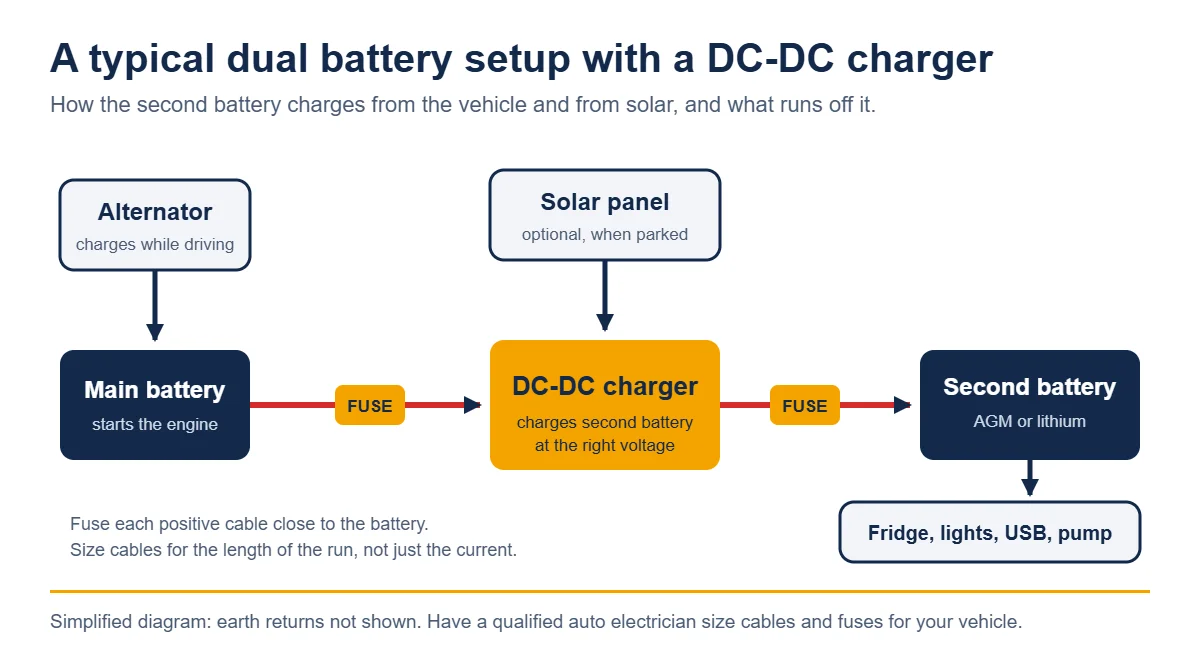
DC-DC charging and smart alternators
Many recent utes and 4WDs have smart alternators, which drop their output once the starting battery looks full. A simple isolator then can't fully charge a second battery, especially a lithium one, and the problem gets worse over a long cable run to the tray or a camper. A DC-DC charger fixes this by boosting and regulating the voltage to suit the auxiliary battery. Our guide DC-DC charger or isolator explains which suits which vehicle.
Many DC-DC chargers also accept solar input, which is useful when you stop for a few days at a camp. Make sure the charger's battery profile matches the battery type you fit.
If you plan to stay a few days at a camp along the Darling or out on a station stay, solar can keep the auxiliary battery topped up without running the engine. The sunny climate west of Cobar suits it well. A portable panel lets you park the vehicle in shade and put the panel in the sun, which helps both the fridge and the battery. Keep the panel's cable short and heavy enough, and use a regulator suited to your battery.
Heat and where the battery goes
Western NSW summers are hard on batteries. Lithium batteries in particular don't like high temperatures, and most have a management system that limits charging when they get too hot. Where possible, mount the auxiliary battery in the cabin, the canopy or a ventilated box rather than beside a hot engine.
Whatever type you choose, secure it firmly. Corrugated roads shake everything, and a loose battery can short against metal or crack its case. Use a proper battery box or clamp, not just a strap.
Cable size and fusing
Thin cable is the most common reason a dual battery system underperforms. On a long run from the engine bay to a canopy or a camper, voltage drop can cut charging badly. Our guide on what size cable you need shows how to size cable for current and length.
A cable that runs between two batteries needs a fuse or circuit breaker close to each battery, so a short anywhere along the run doesn't start a fire. Anderson plugs make a neat, high-current connection between vehicle and trailer. See how to wire an Anderson plug.
Monitoring and simple habits on the road
A battery monitor or a voltmeter on the auxiliary battery takes the guesswork out of remote travel. Check it each evening and morning. If the voltage is lower than usual after a day's driving, something in the charging system has changed, and it is better to find out in Wilcannia or Broken Hill than out on a station track.
Set the fridge a few degrees warmer than you would at home, keep it out of direct sun and avoid opening it more than you need to. On a hot day in western NSW, those small changes cut its power use noticeably. If you also run a camper, check that its battery is charging while you drive, as described in our guide on why a caravan battery isn't charging while towing.
A remote travel electrical kit
When the next town may be 200 km away, a small kit can turn a trip-ending fault into a short stop. Consider carrying:
- A portable jump starter, charged before you leave.
- Spare fuses of every rating your vehicle and accessories use.
- A multimeter or test light.
- Crimp terminals, a crimper, heat shrink, electrical tape and cable ties.
- A short length of heavy cable and a spare Anderson plug.
- Spare globes for headlights, tail lights and indicators.
- A list of what each fuse in your vehicle protects.
Before you leave Cobar
Have the starting battery tested, check both batteries charge properly on a test drive, and run the fridge for a day at home to confirm the system keeps up. Check that every connection is tight and every cable is secured. Tell someone your route and when you expect to arrive, and carry plenty of water.
Cobar is the last larger town on the highway before Broken Hill, so it is the sensible place to sort small problems before heading west. Local advice is on our Cobar page, and if you are heading south into station country, see our Nymagee page.
Parts for this job
Order quality parts online from Ozautoelectrics, dispatched Australia-wide.
Get it done: get a quoteDo it yourself: shop DC-DC chargers
Get it done: get a quoteDo it yourself: shop auxiliary batteries
Get it done: get a quoteDo it yourself: shop Anderson plugs
Get it done: get a quoteDo it yourself: shop portable jump starters
Questions Cobar drivers ask
How far is it from Cobar to Broken Hill?
It's about 460 km along the Barrier Highway, through Wilcannia. Cobar to Wilcannia is about 260 km, with only one roadhouse selling fuel on that stretch. Wilcannia to Broken Hill is about another 200 km. Plan fuel, water and rest stops, and avoid driving at dawn, dusk and night where you can because of animals on the road.
Do I need a DC-DC charger for my second battery?
If your vehicle has a smart alternator, a lithium auxiliary battery or a long cable run to the battery, a DC-DC charger is usually the better choice. It boosts and regulates the charge to suit the second battery. A simple isolator can work on older vehicles with a fixed-voltage alternator and a battery close by.
Can I drive the gravel roads around Cobar after rain?
Cobar Shire Council asks drivers to avoid unsealed roads in wet weather, by choosing another route or waiting for drier conditions. Driving on wet gravel roads damages them and can leave you bogged far from help. Check LiveTraffic NSW and the relevant council road reports before you set out.
Need an auto electrician in Cobar?
Find local auto electricians and mobile services in the Cobar directory, or start with your area: Cobar.
Search auto electrical parts
Searches the full range at Ozautoelectrics, opening in a new tab. Popular: dual battery · LED light bars · trailer plugs · fuses
Run an auto electrical business in Dual Battery Setups for Travel West of Cobar?
- New to Ozautoelectrics? Apply for trade pricing on quality auto electrical parts.
- Already a trade customer? Log in and order parts at your trade price.
- Want more local customers? List your business on this site so drivers in Dual Battery Setups for Travel West of Cobar can find you.
Not confident doing this yourself?
There’s no shame in handing it over. A local auto electrician can diagnose the fault properly and get it done safely, especially for anything involving brakes, airbags, hybrid systems or air-con gas.
Get a quote from a local auto electrician Or shop the parts and do it yourself